

Loss of Humanity
Humanity is a word with many different meanings given the context. One meaning could be when referring to the human race, for example when someone says, “ That's a crime against humanity!”. Another meaning could be the study of humanities: history, art, ethics, languages, etc. In this sense, we will discuss the loss of humanity as it refers to the dehumanization of certain groups of individuals. The loss of humanity can be applied to many atrocities seen in both the past and the present. It was also seen in almost all parts of the world.
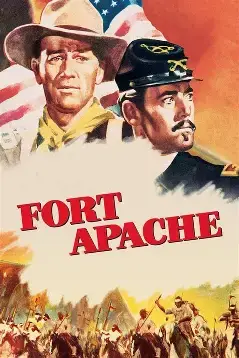
The poem “Dear John Wayne” by Louise Erdrich takes place at a drive-in theatre where a John Wayne wild west movie, "Fort Apache" is playing. The movie depicts a cavalry of men attacking Indian settlers, killing them all on the screen, with John Wayne telling the camera everything they see (the men in the movie) belongs to them. The audience however does not react with pride to the movie, instead they know that it is not right. The poem closes with the mention of the cause of John Wayne’s death, cancer. Comparing the cancer and John Wayne as killing and taking everything. This poem, although showing a negative reaction from the Indian audience at the drive-in, shows how Hollywood depicts the genocide of Indians due the idea of Manifest Destiny - the belief of the US expanding across the American continents was inevitable - as something to support rather than recognize the loss of life caused by it.
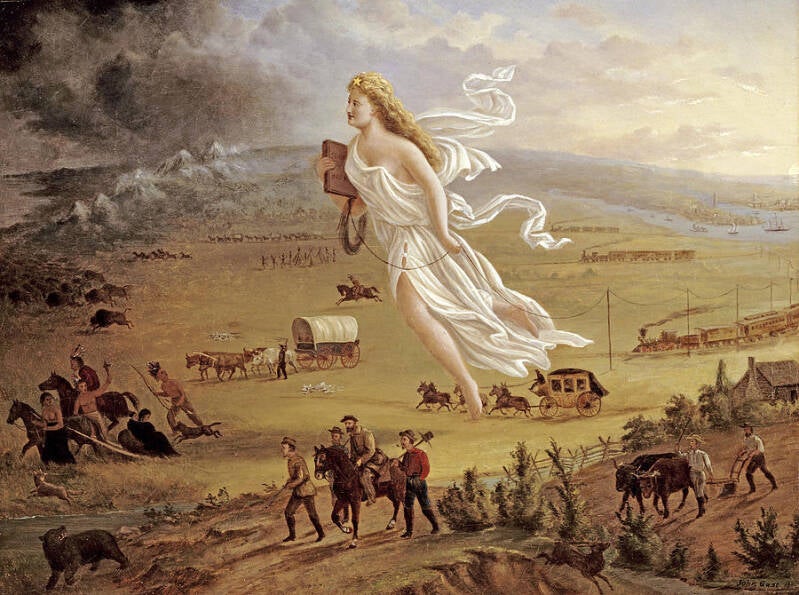
The painting, American Progress by John Gast, is extremely popular and can be seen in most US history classrooms. This painting depicts the idea of manifest destiny, showing an angelic figure and eastern settlers moving towards the untamed west, with Indian tribes, and herds of buffalo horses and other animals running away. This painting using color and light contrast depicts the east as a beacon of hope and a bright future and the west as wild and untamed. It also shows the main figure carrying a book and telegraph wires to portray the expansion of education and communication. Although this painting depicts the hardship of Indian tribes being forced from their homes, it also tries to convince the viewers that the good outweighed the harm caused to these tribes and downgrades the genocide they went through.
These both show a loss of humanity for Native Americans by dehumanizing them to make them appear more like animals or worthless lives. The poem shows this by explaining how the movie kills the Natives with no regard for their lives and takes their homeland for American settlement. The painting also shows this through the shading of the painting to make the native tribes looks menacing to try and get support for the atrocities and genocide they went through. These two examples, show some forms of media that accepts the dehumanization of groups. There are many movies depicting the loss of humanity like "Fort Apache" and they include different kinds of groups including people of color, people of Asian descent, and middle eastern people. There are also paintings depicting this as well for all these different groups.
This resonates with me because I have watched movies and viewed artwork that could be seen as offensive for certain groups however because it does not apply to me, I never noticed. It has become very normalized today to watch shows and be desensitized to death or murder on screen; however, this can lead into how we act in the real world as well. If you do not view other people as human beings, you are less likely to feel inclined to help in a situation or more likely to mistreat others. An example I had recently seen was an experiment where they dressed a little girl up to make her look homeless and had her stand outside. No one stopped to help the girl even when she asked for it because most people feel disgusted or scared of homeless people. However, the experiment was done a second time however they dressed the girl up in a dress and a cute outfit. This time strangers walked up to her to help without her even having to ask. This shows that through TV and media we consume we can become desensitized and start viewing people as less human, however it is important to treat everyone equal despite their race, economic status, gender, and sexuality.
Citations
-
Erdrich, Louise. “Dear John Wayne.” Literature: A World of Writing: Stories, Poems, Plays, and Essays, edited by David L. Pike and Ana M. Acosta, 2nd ed., Pearson, 2013. pp. 533-534
-
Gast, John. American Progress. 1872. Oil on canvas.
Create Your Own Website With Webador